First time here?

First time here? Please check out the FAQ as well as the General Discussion threads. Feel free to chime in or get in touch with comments, questions, corrections... Cheers! :)
Showing posts with label Perth County Conspiracy. Show all posts

Thursday, April 2, 2026

Perth County Conspiracy - Kanada / Break Out To Berlin (1975) [GDR Original]

Perth County Conspiracy - Kanada a.k.a. Break Out To Berlin (1975)

Original East German (GDR/DDR) pressing
AMIGA – 8 55 424  (Discogs)
~ThePoodleBites rip at 96 kHz / 24 bit FLAC + full high-res scans!~

Canadian hippie-folk legends the Perth County Conspiracy released what would be their final album Kanada (a.k.a. Break Out To Berlin) behind the Iron Curtain in East Berlin, February 1975. The album was recorded in several sessions over a three-day period, following the group's appearance at the Fifth Annual Festival of Political Song, where many (communist and predominantly state-sponsored) bands from the Eastern bloc and other countries gathered from across the world. With statewide broadcast of the festival providing advertising, the final PCC album reportedly sold upwards of 80,000 copies in the Soviet bloc. Whether or not that figure is true, it certainly stands as one of the band's best efforts, and it was cut with an audiophile-level quality of high fidelity, making it sound terrific even 50 years later.

Many thanks to Richard Keelan for his wonderful insights into the creation of this terrific album!

Front cover of the East German edition.
The band display their signature tapestry, as also integrated on the cover artwork of their debut album.
The band released several albums following their masterpiece Columbia debut, and while to my ears none made it to the same high musical standards as their first, this album probably comes closest. In many ways it feels like PCC's parallel to the Beatles' White Album; maybe that's an over-exaggeration, but Richard Keelan and Cedric Smith have their own songs recorded with the rest of the band with minimal intermingling. Hearing these two individuals separated, it suddenly occurs to me why the band's formula worked so well: Keelan and Smith form a divine counterpoint to one another, with Richard's soaring, angelic voice relaying holistic and even idealistic poetry that lingers mentally long after exiting the air, till Cedric cuts through with his cynical irony and humor, his raspy voice bellowing lines of a story like a playwright. It's these two elements mixed together, and their mutual respect for one another, which makes this album (and band) so great.

This record was released with two different covers and titles: Kanada in the GDR (distributed throughout the broader Soviet bloc), and Break Out To Berlin on the band's home turf of Canada. Richard Keelan remembers: "Now, I'm not sure if you're aware that there are two versions of this album; the Amiga (German) pressing is surely the best quality vinyl I ever recorded – hands down! However, we also pressed our own batch (again at RCA) with our own printed sleeve, a red, black & white high-contrast photo of the Brandenburg Gate as viewed from East Berlin ... We titled it 'Break Out To Berlin'. ... but! The vinyl was crap compared to the Amiga vinyl. The actual German pressing is entitled 'PCC Kanada' – we titled our domestic repressing 'Breakout to Berlin' ... I tend to favour 'Kanada' mit ein 'K' ... heh ..." Indeed, the GDR pressing quality is audiophile-grade, which makes this album a joy to listen to. Musically it's a perfect snapshot of the political era, with some timeless masterpieces worked in as well: "I have no way to know whether UToob postings of tunes from that album are from the OG or our repressed version. Either way, I do know a lot of the material on it is somewhat dated, politically speaking. But I also know my 'Voice in the Wilderness' is the favourite song of mine I have ever recorded ... one of my best, in my humble opinion."

Front cover of the Canadian edition, showing the Brandenburg gate from Pariser Platz on the east side.
The band's name is listed as PCCDNEGDR -- that is, the Perth County Conspiracy Does Not Exist in the German Democratic Republic.
The album kicks off with Cedric's "Old Ways," a short, nostalgic rememberance of more difficult yet camaraderie-driven days. This song has only two stanzas but immediately establishes the album's tone while simultaneously reflecting familiar back-to-the-land ethos from the group's earlier LPs:

Oh, it isn't like the old days
But there's a feeling still around
Of a time when independence wasn't being alone
Looking out for one's own

And he still recalls the old ways
When the horses pulled the plow
Now life was hardly simple, but a neighbor lent a hand
And you worked close to the land

Cedric, riding one of his horses in the back forty of Perth

The musical arrangement is a reflection of the lyrics: a solemn back-county jam led by acoustic guitar and fiddle. This album generally has much less studio tomfoolery than the earlier LPs, and as such it feels very organic. The medley smoothly transitions into "Hooray For The Farmer," a reverent ode to farmerhood, first recorded for the band's earlier live, self-released Rumour LP What School Bus Tour. Straight from this first track, it's clear: the PCCdne is back.

This near-perfect opener is followed by pianist Paul Gellman's sole songwriting contribution to the album, "Breaking Down The Walls," a frankly strange symbol to use on this predominantly socialist album recorded not far from where the real and quite symbolic Berlin Wall still stood. It hardly sounds like the same band; Richard does backing vocals while Paul takes lead, which is understandable but definitely a less professional sound. However, Richard's first contribution, "Heart Of The Beast," immediately follows and more than compensates for any possible deficiencies, with intricate lyrics, internal rhymes and wordplay: "Between the bankers and the police / I'm lookin' for a little rest in peace," but sounding like "rest 'n' peace" until you hear "a little R.I.P." in the final verse. Indeed, who hasn't tempered that very mood? – I'm reminded by this theme of Pink Floyd's "Welcome To The Machine," but "Beast" has a much more uplifting spirit: an almost acceptance, or self-awareness of sorts.

The spirit remains largely the same till Cedric cuts through with his keen, jaded "Lining Up To Go":

Oh, there's been no rain, and the crops are the same
as the day we put them in
No money around, and no work to be found
and Mabel says it's 'cause we've sinned...

Oh, the freight cars were rough, and I sure had enough
of soup lines and taking the dole
I used up my prime serving hard times,
now how could I end up in the hole?

Hearing this verse I feel that Cedric really meant those lines; it would only be a few years until the Perth County Conspiracy -- that is, the loose association of Ontarian farms, and not just the recording act -- had totally disintegrated. You can still feel the reverberations of that idealistic dream from the first LP, but also begin seeing cracks where it's breaking apart. In any case, I think this song is really about Canadians going to serve in World War II: "when the mad dogs of Europe barked at the moon and we were lining up to go."

After "Live With Me On Earth," which is Milton Acorn prose set to music, Richard reemerges on side 2 with "Touch A Spark," an inarguable album highlight; even after hundreds of listens, its beautiful, lilting chorus still gives me chills:

The lightning arcs and the angels sing in the spring sky
Spark a touch and the feeling is such
That all living things are free to fly
Away, away, away we go in order to return again

"Military Spectatorships" -- a rare feature combination of both Richard and Cedric vox -- is a dated parody of Cold War-era Western insensitivity to happenings abroad. Cedric's lead – scathing – makes reference to Henry Kissinger among others. This short song is then answered by Keelan's "Richard's Down," where "Richard" refers not to Keelan, but to former U.S. President Nixon. The song, written in a minor key, encourages, above all, love: "to keep the world from falling apart." It's this amazing back-and-forth interplay between Richard and Cedric, positive and negative, jubilation and sorrow, love and war, that adds incredible depth to the songs on this LP.

Apart from a cringe-worthy line in "Dance Of The Fat" ("We can streak to the moon in a silvery penis"), the program straightforwardly ventures on till the album closer, "Voice In The Wilderness," the final song the band ever released; and wow, what a valedictory coda it is. Suddenly all of the politics, the inner struggles, the woes and the fears are vaporized: it's a timeless, life-guiding musical statement, as ripe in idealisms as Relatively Clean Rivers, running free with wildlife and natural imagery, parallelizing purification of one's own journey and will. Its permanence permeates every song the band ever recorded.

The original GDR edition of the album was apparently sold at 16,10 East German marks (Ostmark), which assuming the country's "official" 1:1 exchange rate with the West German mark, would equate to about $41.42 in 2025 U.S. dollars. Of course, the Ostmark traded on the black market for a fraction of this price -- but it still shows how expensive it was to an Eastern Bloc worker at the time. The government-controlled record label sold it off as follows:
Liner notes on the East German LP

The following tracks were recorded by the Canadian group "Perth County Conspiracy" during the 5th Festival of Political Song. The group members live on various farms in Perth County, where they earn their living by making toys and handicrafts. Their music, heavily influenced by their country's folklore, also incorporates elements of rock. The lyrics are characterized by a wealth of poetic imagery, and they strive to reflect and simultaneously transform the existing order, aiming to use song as a weapon in the struggle to create a better social order. However, wordplay and idiomatic expressions do not always allow the meaning to be immediately clear to the listener in translation. What is evident, though, is the group's desire to publicly express their progressive views, even in capitalist countries. This is why they refer to themselves as "Perth County Conspiracy does not exist," a group that does not exist as a conspiratorial formation.

Indeed, when listening to the album, more progressive political elements surface, but they're not overwhelming; the political messages, when they even appear, are more generally statements of discontent and reflections of poverty than all-out communist worship (another, I guess, similarity with the White Album -- or not). The Canadian edition had a more simple and graceful message on its cover:
Front cover text on the Canadian LP

A heartfelt thank you to the people of the GDR for their hospitality and for the opportunity to make this record. We would like to share this experience with the people of all socialist countries.

Back cover of the Canadian LP, with credits for the musicians
and facilities involved in its production
Back cover of the GDR LP, with similar credits and rough
translations of each song's lyrics
Richard Keelan, one of the architects of this great record, kindly agreed to share his recollections about its history:

I'll try to recall how this all came about as best I can nearly 50 years after the fact. We received an invitation to take part in the 'Fifth Annual Festival of Political Song' (I think that was the title – I'd have to look it up). Anyway, our participation was advocated by a guy named Michael Friedman, a Canadian who was studying music in East Berlin at the time (he is pretty well-known singer-songwriter now living in Vancouver, BC). Somehow, our participation was approved by the Canadian government(!), and we were flown via KLM Airlines to Amsterdam (pre-paid!); then we boarded a Polish airline plane (maybe the Polish airliner), a two-engine prop plane that shook and shuddered its way to East Berlin. We ended up ensconced the Stat Hilton, the absolute most modern edifice we could see in the city – a sleek, modern needle of a hotel overlooking a square called Alexanderplatz (I think... somethin' like that...).

As you might guess, we were a definite anomaly at this Festival; most of the folk groups were from Russia, Denmark, GDR, South American countries, wherever – almost all of which were affiliated with their respective countries' Communist parties, if not actually sponsored by same; we were not! (Our closest connection to the Communist Party of Canada was our friend, the great poet Milton Acorn, who defiantly maintained his membership in the Party most of his life.) ... We were a bunch of anarchic hippies from a first-world country in a country that would disappear from the planet within a decade or so ... it was, um ... weird, to be sure.

Excerpt from an article in the East German
newspaper
Neues Deutchland, 11 Feb 1975

With Red Songs in the Class Struggle

Revolutionary Singers Seek Experience in Berlin

  The group "Perth County Conspiracy" comes from Canada. With their songs and programs, which also include dance, pantomime, and cabaret, they aim to educate the public in their country about the social, cultural, and historical situation. Cedrik Smith [sic], the group's spokesperson, describes Canada as a veritable cultural colony of the USA. "All you have to do is turn on the television – it's all from the States." The group doesn't just want to state facts, but also offer alternatives and appeal to Canadian national pride. They perform for students and farmers, in prisons, churches, and union halls. Today, they belong to the growing progressive front in Canada, which is advancing for national independence and the victory of socialism.

Songs of Victory and Confidence

Tuesday Evening Program at the Volksbühne

  Signals, reports, and commentaries on the freedom struggles of other peoples will also be presented at the first evening event on Tuesday at the Volksbühne in Berlin. The Canadian group "Perth County Conspiracy" will perform. Five young people who, with their songs, not only champion national independence from the USA but also consistently engage in the spirit of anti-imperialist solidarity. In "How a Body Richards Down," they sharply criticize the Canadian government's willingness to compromise with the ruling clique of terrorists and murderers in Chile. The young people in the packed Volksbühne hall stand with their Canadian comrades, applauding them long and heartily, wanting to hear more.

Neues Deutchland, 12 Feb 1975
Now, we were only there for about ten days, and most of the days were a blur, with three or four memorable performances that come to mind: the main one was in the major concert venue (Opera House?) in the city ... possibly a 10,000 seater, which was also televised around the country. Most of the groups, including us, did sets in the course of that evening. On another day, we were asked to rise early one morning, and were bused to the outskirts to perform a set at a wire factory for the workers in their cafeteria for lunch ... That was a pretty gritty gig that felt really good to do in terms of connecting with the reality of the place – which, overall, was pretty grim, not unlike the depressing feel of the whole country. About the only natural resource there was brown coal, which fuelled the place with a blanket of coal-smog hanging in the air... and the coal-fuelled street lighting was dim, dull, and yellowish.

 Neues Deutchland, 13 Feb 1975

Meetings in Berlin Companies

A Premiere: Among Workers

"This is a premiere for us," said the five singers of the group "Perth County Conspiracy" from Canada. "Here at the KWO, we're singing for workers in a factory for the first time." Their visit to the Berlin cable factory workers offered the Canadian friends ample opportunity to get a picture of a large socialist enterprise and the workers who are in charge here. During a tour of various factory departments, they witnessed how many thin wires eventually become thick cables for telephone lines, which allow 960 simultaneous conversations to pass through. But machines and products alone do not characterize the new, socialist production conditions. And then there was a plethora of questions for representatives of the management and for members of the Free German Youth (FDJ): "Can a worker simply be fired here? What training opportunities are there? What is the position of women in the factory?"

 For the members of the "Perth County Conspiracy," some of the answers prompted them to speak about the capitalist society in their homeland. They reported on rising unemployment and increasing corporate profits: "Eighty percent of the profits go to the USA."

 They long for the kind of opportunities for contact that existed in the GDR. In Canada, singers like them find it very difficult to connect with workers in factories. "We mostly sing at universities, but we've also performed in prisons." Questions and counter-questions abounded. The schedule became disorganized. The late afternoon performance at the KWO clubhouse was pressing.

Official logo of the festival:
a bird beating a drum. The
Freie Deutsche Jugend (FDJ) symbol
appears on the drum's rim.
Other than those occasions where we performed, I also recall a party gathering for the performers sponsored by the Young Communist League... or Committee, or something. These 'young commies' were just really young people like us – some beards, a little longish hair, liked to have a beer, shared smokes. Larry Brown told me later he'd chatted up a girl (he was renowned for his, uh...charm) ... They ended up under a piano with a floor-length cover on it, where they became acquainted 'biblically', shall we say ... rascal! Later, as we walked across the plaza to our hotel, I was quietly tootling on my pennywhistle when out of the darkness appeared two green-coated Stasi with shouldered rifles; they asked what we're doing, we indicated our hotel destination, and they warned me ... "musik NICHT!", and I put the whistle back in my pocket.

Here's another VERY vivid memory: we had to go to the Amiga Records office to collect the 10,000 marks we were offered to go into the studio; Paul Gellman and myself went to said office... which was located in the former villa of Hermann GOERING...! It was located on the edge of steep-sided valley overlooking the frontier (demarcated by crossed timber posts [XXX strung with barbed wire] patrolled by more pairs of green-coated Stasi). We noted bullet-hole chips still in the walls around the front door. I should point out here that Paul was a Jewish lad from Richmond Hill (north Toronto), accompanying me, the IrishAmeriCanadian guy, to pick up East German cash at Goering's villa ... you could NOT make this shit up, I must say.

Spending a share of 10,000 GDR marks really was difficult to do – most any kind of clothing available I wouldn't wear on a bus! ... drab colors and east Euro styling of the mid-'70s. The shoes were in a dull rainbow of choices in brown or black ... or grey. The most memorable gew-gaw I bought was a Russian made stopwatch which performed according to its name – it stopped soon after I got back. I may have given some marks to the young Commie friends we met, drank beer and shared smokes with ... I think I had some Deutschmarks left when I got home.


So we had three days after the Festival to record all the material on the album. We did quite a few sessions (not sure how many) in those remaining days; I recall at least one at night, and another vivid image remains with me from that. The studio was on a dead-end street that was blocked by The Wall, and as I was at the top of the steps down to the studio, the dull yellowish street lights lit the street where I stood, while above the Wall, those huge rectangular mercury street lights brightly lit up the street on the West Berlin side; it was a very stark visage.

The studio was a large subterranean space where it was obvious that classical music was recorded there. There was a lovely 9 foot grand piano, vibes, tympani, etc., and what seemed to be pretty good mics and other hardware. The one failing was that a decent bass amplifier was lacking ... what they had was a goinky little amp with an 8 inch speaker that had seen better days. The upshot ... Larry Brown sat in a chair behind baffles, headphone on right ear to hear what we were playing, hunched over with left headphone off his ear so he could hear himself in that tiny amp...! In particular on 'Richard`s Down', as the tune accelerates into a faster tempo on my guitar solo, Larry walks that bass like a boss...! ... I am not even sure what 'time' we were in at that point, but it was cookin'! ... Underpinned by his bass – not to mention Paul's remarkable piano work, as well. That song, as well as 'Voice...', were laid down on the last day by just moi, Paul, and Larry (my memory is vague here, but I think Dorit, Cedric, and Harry left to visit friends in London before we three finished those songs – I don't hear Dorit or Smith's voices on the overdubs, at any rate). I spent a while at the end writing several pages of notes on mixing the songs – because the album was mixed by staff after we had left the country...! The mix turned out OK, with some flaws I didn't care for – like the maracas on 'Touch A Spark' being mixed too high; a few other minor flaws as well, but overall, it came out pretty good. We were told later on (somehow) that as many as 80,000 copies were distributed (sold?) in the Eastern (Soviet) bloc; no idea if that's true.

Paul was committed to get back to T.O. immediately, but Larry and myself decided to take a train north to go to Copenhagen before we went back to Amsterdam for our flight home. As we were about to cross the Frontier to the west, two Stasi came to the door of our compartment demanding I.D.; we handed them our passports, and mine being a U.S. passport, one of them said "humph, Amerikanicher" with a suspicious glance ... I nodded, they handed back our passports and moved on. It was a relief to get out of there, frankly. There is more to the story as Larry and I made our way on the train to the North Sea and beyond, but I'll save it for later ...


Recent street view of the old AMIGA recording studio
Brunnenstraße 154, Berlin, Germany (source)
Track listing:
1) "Old Ways / Hurray For The Farmer" -- 2:43
2) "Breaking Down The Walls" -- 4:41
3) "Heart Of The Beast" -- 3:43
4) "Mothers Blues" -- 3:47
5) "Memory Stains / Lining Up To Go" -- 3:42
6) "Live With Me On Earth" -- 2:43
7) "Touch A Spark" -- 3:37
8) "Military Spectatorships" -- 1:50
9) "Richard's Down" -- 3:55
10) "Dance Of The Fat / You Growing" -- 3:10
11) "The Pioneer Song" -- 3:10
12) "The Voice In The Wilderness" -- 3:10

Vinyl condition: M-
Dynamic Range: DR 12

Equipment / Lineage:
– Audio-Technica VMN40ML stylus on AT150MLx dual moving-magnet cartridge
– Audio-Technica AT-LP1240-USB direct drive professional turntable (internal stock preamp/ADC removed)
– Pro-Ject Phono Box S2 Ultra preamp with dedicated Zero Zone linear power supply
– Focusrite Scarlett 6i6 MkII (96kHz / 24bit)
– Adobe Audition CC 2024 (recording)
– iZotope RX 11 audio editor (manual declicking, EQ subtraction, additional adjustments)
– Audacity 3.x.x (fades between tracks, split tracks)
– Foobar2000 v2.x.x (tagging, dynamic range analysis)

Thanks for taking the time to read my posts and check out my blog. I'd greatly appreciate it if you leave a small comment below. Notes from my readers are what inspire me to keep going. Thanks!
MEGA: https://mega.nz/folder/52tXSRRJ#7u8o9gBwbaAGdlPBO0ot9w


Neues Deutchland, 13 Feb 1975

Songs That Unite Us

"Viva Chile!" - The solidarity at the festival

Since the beginning, the global theme has resonated

  If it weren't for the language barrier, our Chilean friends would have learned even more about the thoughts the groups express in their songs. These thoughts were audible throughout the festival, right from the start. ...

The Perth County Conspiracy (Canada), participating for the first time, "wonders" why their government, even though their ambassador in Santiago was abroad buying a limousine during the coup, nevertheless recognized the junta 22 minutes after the coup.


Monday, December 20, 2021

The Perth County Conspiracy - Does Not Exist (1970) [Canadian LP]

The Perth County Conspiracy - The Perth County Conspiracy Does Not Exist

Original 1970s Canadian LP (superior repressing)
Columbia ELS-375 (Discogs)
~ThePoodleBites rip in 96 kHz / 24 bit FLAC + full high-res scans~

 Do you care to keep your head in motion?
Close your eyes and open up your ears
Who you are is only an illusion
And what you are determined by your fears

It wasn't until the last couple of years that I gave the major-label debut from these uncanny Canadian hippies the full-length bout it demands. The miserably NR'd MP3s that had lived on my hard drive for eons made it neigh impossible to play Does Not Exist without an accompanying cloud of disdain and annoyance, hovering over and obfuscating the band's crystalline authenticity, which finally began to emerge upon playback of an LP lent from the stores of the record phantom. While it was surely a revelation hearing this album with all of its character, its ambience, its poetry, its vibrations, all fully intact and breathing, the challenge of this project promptly became equally striking: at the considerable length of nearly 53 minutes, obtaining a digital capture of this spiraling excursion with the broad dynamics unharmed while keeping levels of noise inaudibly low would be challenged by the quiet mastering, the haphazard scale of mass production, and the years of accumulated groove wear which can make such lengthy pieces of repertoire a symphony of hiss and pops. 


But it's certainly worthwhile: sometimes stuck in my head for days on end, several of these "Americanadian" hymns seem to stow away into the brain's tiniest cracks, so that no amount of repeated listening can wash them out. After dozens of play-throughs, the words still inspire pondering in novel fashion, and while the music bares distant resemblances to Fairport Convention or the Incredible String Band, the mood is more like rural America (think CSN) than urban London or vacant Scotland, which provides a somehow refreshing change from those well-loved Canterbury acts. Certainly the top concept folk-psych piece out of Canada and probably one of the best on Earth, Does Not Exist makes me wonder again how masterpieces such as this could be nearly forgotten in a world where inscrutable cacophonies like Oar or Comus or le dernier cri are regarded as "classics" by the avant-hipster. The critical music world, or perhaps the ghosts that control it, have not been fair even in their reassessments, so for this case I will try to even the score.

 Many thanks to C.F. for lending a preliminary copy of this album, and for his indispensable observations!

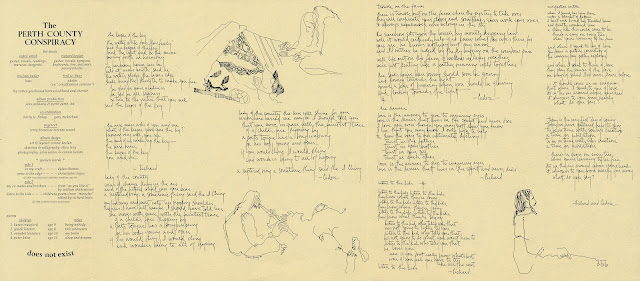
Original album cover designed by Richard Keelan's then-wife Connie, a graphic designer who studied at the Parsons School of Design in New York City

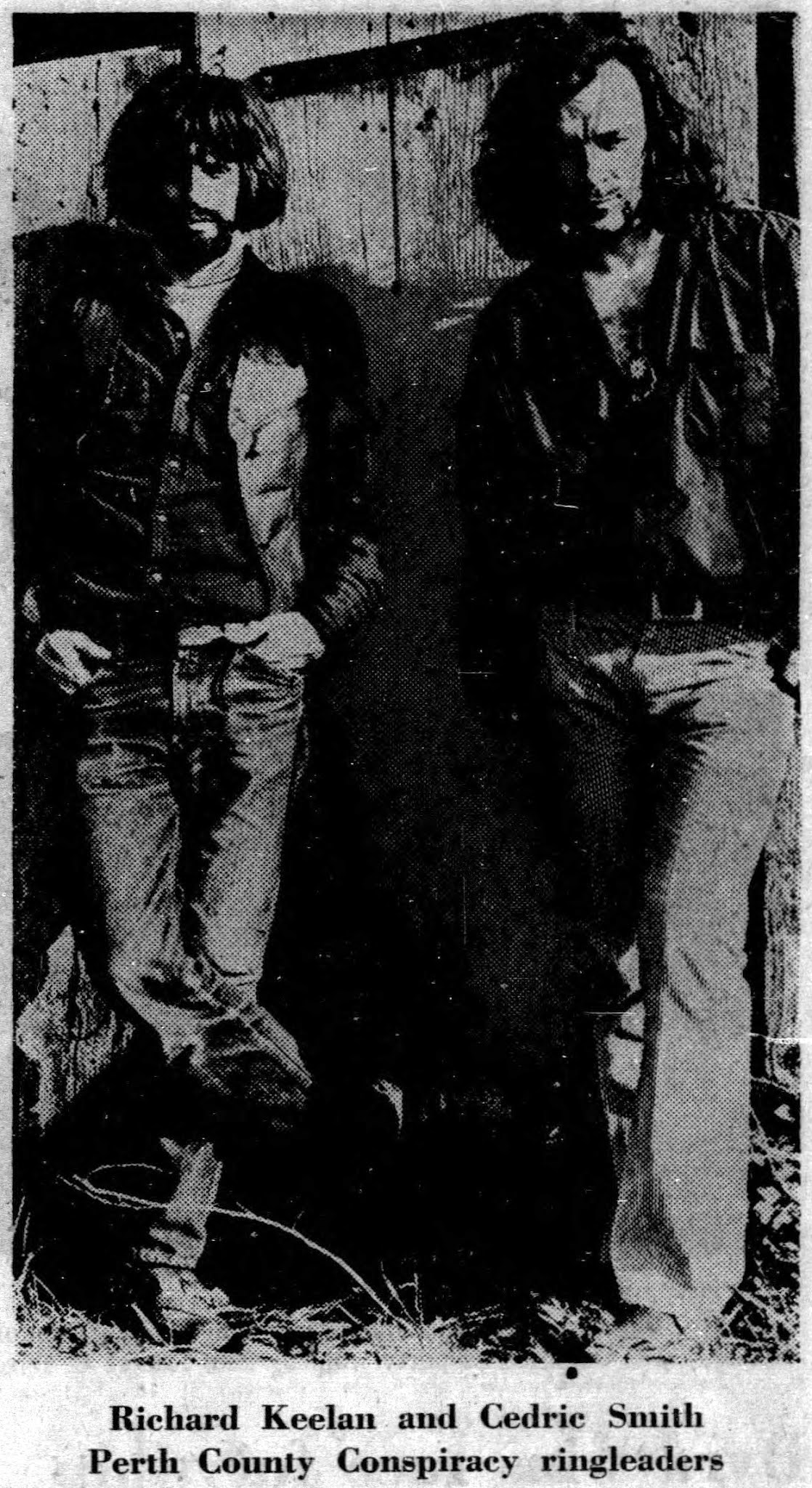
Stealing the location in their name from the county in southwest Ontario, the Perth County Conspiracy called the area surrounding the small town of Stratford their home, a place that sits somewhere between Detroit and Toronto, a town rural enough that even today, 50 years later, it is still crowded primarily by agriculture and dairy farms. The group was far from being homegrown Canadian, though; guitarist, vocalist, and songwriter Richard Keelan was a Michiganian with previous allegiances to the Detroit garage-folk band The Misty Wizards (along with Ted Lucas from The Spike-Drivers), and fellow folk smith Cedric Smith was an Englishman with a fascination in literature and theater. The "Conspiracy" moniker was inspired by the Chicago Seven trial's controversial definition of a conspiracy as "two or more people in the same place breathing together"; void of defined structure, a spokesman, or any other concrete form.

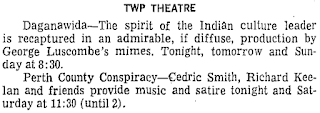
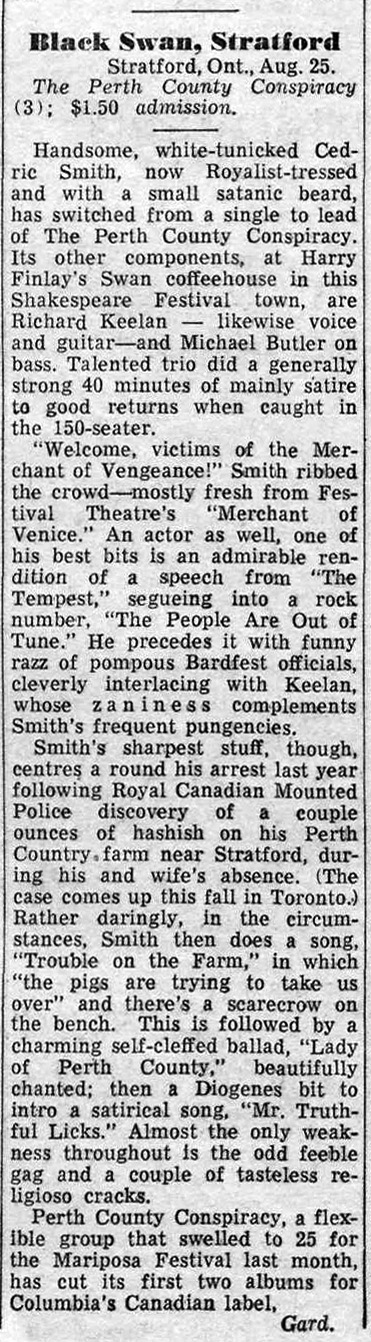
Relocated to the Canadian countryside from the young age of 9 or 10 years old, by the age of 17 Cedric Smith had dropped out of high school to pursue a career as a folk singer, and began performing at local coffeehouses such as the Black Swan in Stratford around 1961. Local actors were known to frequent the venues, and Stratford being the home to a prominent and renowned annual Shakespeare Festival, Smith had acquired an interest in performing works of the 16th-century writer himself. In 1983 he described his feelings towards the bard as ambivalent; he used the description of a "reactionary old fart who wrote plays to justify the Tudor regime," but he also specifically named the Henry IV plays as his favorites "because of the outlaws in them. I've always connected with outlaws. They're the kind of people who come in to coffee houses late at night."

Smith got his first chance at performance in 1964. Although he had never taken any acting lessons, artistic director Michael Langham asked him to audition for the Stratford company, which succeeded after some brief coaching from Kenneth Welsh. It ended as a quite successful season, but Smith's commitment to acting was sporadic and continued to be interspersed with his farming and folk music interests. After another season with the Stratford company in 1967 and a 1969 production of 'Che!' (Guavara) which went to the Venice Festival, Smith began to focus on working with a part-time collaborator and recent transplant to the Stratford area, Richard Keelan. 

Photo from The Windsor Star, 22 January 1971
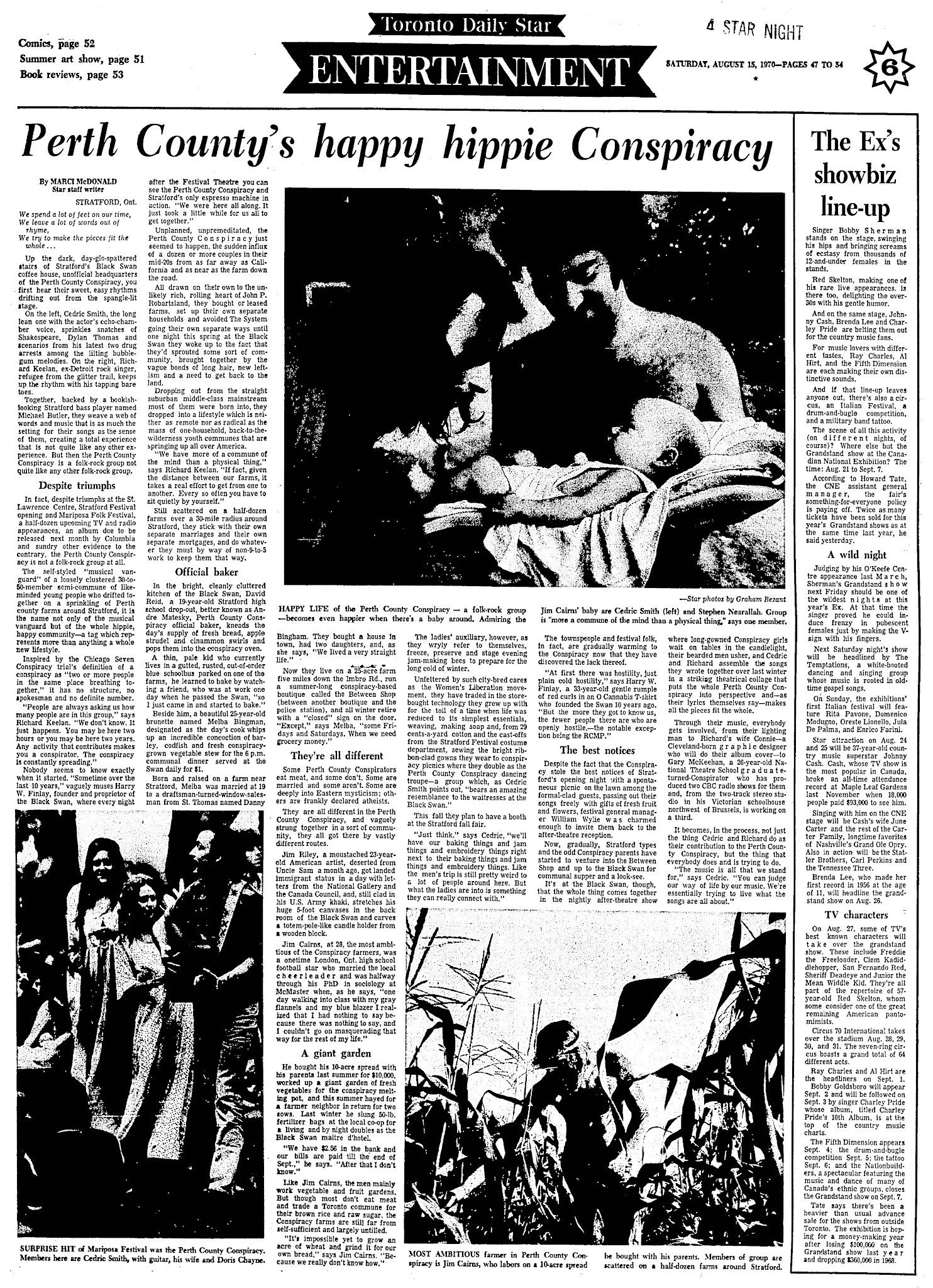
Together, the two expats formed -- or perhaps only named -- what they called The Perth County Conspiracy. The Conspiracy was more than just a performing act; at the heart of the coalition was a "rural way of life": a spontaneous happening and loosely-knit community between seven farms of around thirty permanent residents, and many more who were constantly in flux, who met together at the local coffeehouses, talked, discussed, and shared vegetables, bread, nuts, toys, and similar necessities in a communal setting. Keelan explains in the 15 August 1970 edition of the Toronto Daily Star how dynamic the group was: "People are always asking us how many people are in this group... We don't know. It just happens. You may be here two hours or you may be here two years. Any activity that contributes makes you a conspirator. The conspiracy is constantly spreading."

The establishment was not a typical commune in any ordinary sense, though. Keelan stated in the same paper: "We have more of a commune of the mind than a physical thing... In fact, given the distance between our farms, it takes a real effort to get from one to another. Every so often you have to sit quietly by yourself." 

Another one of the Conspiracy members, Lynn Pearl, a Ph.D. in research psychology, states in the 6 March 1971 edition of The Ottawa Citizen: "There are always new faces turning up... One person pays the rent, but in terms of running the house, everybody who is there helps. We grow vegetables and eat from the garden in the summer, and what's left over goes to the Black Swan... The musicians are just the performing arm, but they wouldn't exist without the others."

An obituary for painter and co-Conspirator Jack McClure in a 6 March 2003 issue of The Globe And Mail (another Toronto newspaper) reveals that there was indeed at least one communal farmhouse extant, nicknamed "Puddlewalk," where draft dodgers, artists, actors, musicians, intellectuals, and local hippies would all live, work, and craft under the same roof.

Smith and Keelan began frequently performing with electric bassist Michael Butler, who together would form the core of the Conspiracy's usual musical performances. Trailing along would come a crew of dozens of ever-evolving Conspiracy members, providing camaraderie, moral support, and sometimes musical assistance. By the spring of 1970, the group began to attract local headlines. They became known for mixing theatrics into their musical performances; Smith, with his affinity for acting, would integrate readings of Dylan Thomas, Shakespeare, or "scenarios from his latest two drug arrests" mid-song, while Keelan, a "refugee from the glitter trail, keeps up the rhythm with his tapping bare toes."

Early concert ad in The Globe And Mail, 16 January 1970

In March and April the group performed for the Rochdale Peace Centre, an entity formed by another commune where in fact some Conspirators resided, based on the 14th-floor at Rochdale College. (An interesting side note: in the case of a raid, from this high vantage point, any police could be easily seen converging outside, so the residents purposely rigged the elevators to run so slowly that there was sufficient time to clean house before any Mounties could start knocking.) Along with the PCC played fellow Canadians Mother Tuckers Yellow Duck and a band called Leather, and although they performed to sparse crowds, all proceeds generously went to the school's education fund. These Conspirators, now attracting significant attention from local media, also apparently made several live appearances on local radio and television, most of which unfortunately seem to have not survived, or at least have not yet been made publicly available.

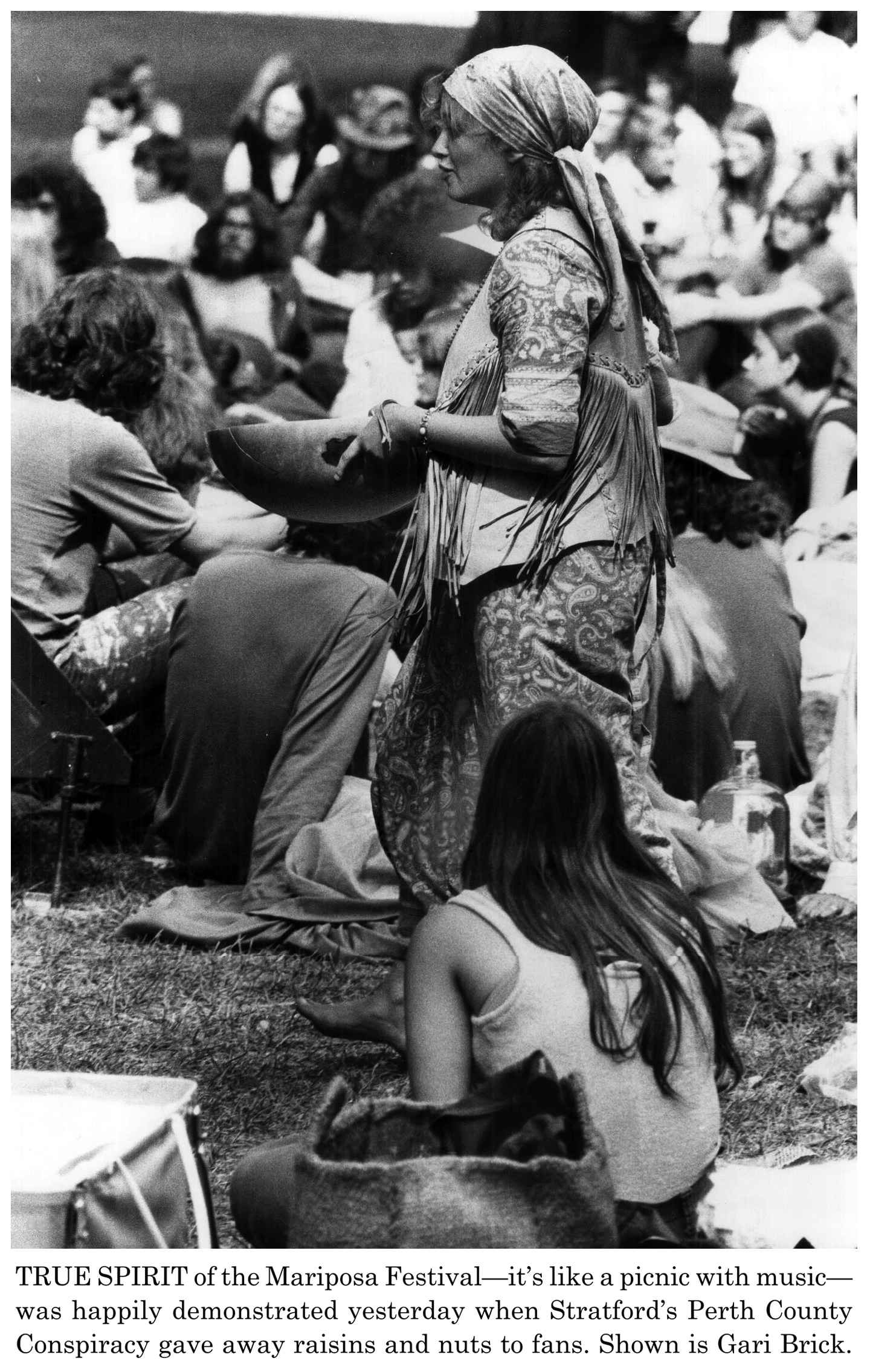
The band made headlines again for their performance at the Mariposa Folk Festival on Centre Island, Toronto, where they were a "surprise hit" amongst headliners Joni Mitchell, James Taylor, Doug Kershaw, and Ramblin' Jack Elliot.

Toronto Daily Star, 25 July 1970 (recreated / photo by Graham Bezant)
Variety Magazine, 2 September 1970

By this time it became known that the Perth County Conspiracy had signed a contract to record for Columbia. Not much was written about the sessions contemporaneous to the recordings, but later reflections reveal that there were some slight tensions with Columbia which would later grow to outright resentment over the company's dubious monetization strategy for the band's second album, Alive. However, any initial disagreements between the band and the label over the presentation of the music here were minimal, with the band being given much artistic freedom. Budding Columbia engineer Terry Brown helped craft the band's musical collage into album format, but the song arrangements in fact remained very similar to the band's live performances in Stratford and Toronto. Regardless, some participants later lamented that the conglomerate should have tried to record the album without the influence of a big record company -- which in fact the group would later do several times, but with varying levels of musical ingenuity. At any rate, the final product from these well-financed, professional-studio sessions is now generally recognized as the band's crowning musical achievement.

The elaborate album artwork was handled by Richard Keelan's then-wife Connie, a graphic designer born in Ohio but raised in New York, and prominently featured the effort's full name as The Perth County Conspiracy Does Not Exist. This was apparently a bit of a quip for the band, who remarked that their commune was so loosely knit that it barely existed at all. Bryan Johnson explained this in a 8 January 1977 retrospective piece for The Globe And Mail:

"It used to be the Perth County Conspiracy's little joke, something they tacked on underneath their name on record albums or chanted in the background at concerts. 'The Perth County Conspiracy,' in big letters, then in tiny script 'Does Not Exist.' A whole metaphysical discussion ensued if you asked about it. All about how it wasn't a commune or anything, just a loose association of people, and how the instant you defined it, you destroyed it, so really, it didn't exist."

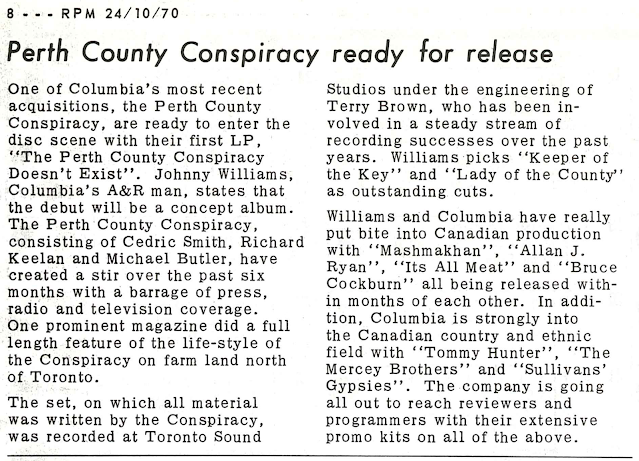
Album release spot in RPM Magazine, 24 October 1970
Though the album was due to be released in September, it seems to have appeared a couple months later, with several local newspapers printing positive initial reviews on 17 November. For a group of hippie folk farmers, the album really is an astounding accomplishment. Conceptual in structure, musically rich, and lyrically complex, it comes across more as a multitude's nitpicked pet project: well-mixed with top-of-the-line equipment, clearly using at least 8 tracks, where sometimes it seems that half of them must've been dedicated to Smith & Keelan's lilting overdubs; each album side bursting with music, as if they were forced to trim each musical idea into its purest form before stitching it with others into a perfectly flowing framework of dual acoustic guitars, bass, lots of vocals, and tastefully added snips of percussion and field recordings. 

The opening track, "Midnight Hour," is a staggering 6-part suite of nearly 7 minutes in length, featuring (in true form) a Smith reading of Dylan Thomas' "In My Craft Or Sullen Art," along with his own "You've Got To Know" sandwiched around Keelan's "Love To Make," the two songwriter's voices blending perfectly throughout the entire recording; perhaps it was just a lucky stroke, but the meld and movement is so perfectly seamless e.g. McCartney-Lennon, and even academic in some sense, that one recognizes these thoughts as pervaded from some highly sophisticated consciousness, typical of the Bob Dylan-esque folk music icons who undoubtedly provided at least some inspiration for these North-American nomads. 

The album soon drifts into "Easy Rider," a gloomy reflection upon the cult movie of the same name. The film certainly must have resonated with this group, a commune and dance crew not unlike the one seen praying for harvest in the movie. Perhaps that's why Keelan sings "Easy Rider is a true story / Easy Rider isn't easy to take..." with the foresight of what might lie in wait for his own conspiracy. Unfortunately the second-half of this track is marred by a strange anti-war gore chant which marks the lowest point for the LP.

The poetic dance of "Truth And Fantasy" followed by the lessons of "Don't You Feel Fine" give way to the side closer, "You Have The Power," with familiar reverberations of the album's opening mantra reappearing before fading into laughter, crickets, and sounds of the country. "The Keeper Of The Key," which opens the B-side and was chosen by the label to mate with "You've Got To Know" on the single release, is a harmonious, layered folk ditty with delicate use of organ during its blooming central section [PL: "you have to be dead from the neck up not to worship this tune."]. "Listen To The Kids" is another moving, contemplative sound collage utilizing rather impressive children's poetry recited from a book called Miracles: Poems By Children of English-Speaking World, originally compiled by Richard Lewis from kids in 18 different countries where English is the mother tongue. Other reviewers have cited this track as a low point for the LP, but I rather adore it, as it strikes me as yet another successful fusion of startlingly poignant literature -- and staggeringly emotive when spoken by a little girl -- onto the Conspiracy's lavish and progressive musical tapestry.

As the Eastern-style strumming of "The Dancer" yields to the album closer "Crucifixation Cartoon," the album reaches what many consider its crux. The mood is rather haunting, with a simplistic descending bass line in the key of D minor, introduced by an acoustic guitar, soon joined by an electric cousin, then accented overhead by pizzicato, later bowed, ukelin; but the lyrics are difficult to parse (for me): "there's a cross on every tree / when you're learning to be free..." It seems perhaps to be a song of finding new love and jubilation, a bit confusing when juxtaposed with the dark mood. Maybe the Picardy third concluding the album is meant as a smile materializing from the shadows, or perhaps it is purely reverence in reflection of the heavy words being spoken.

Album release advertisement from Columbia Records in RPM Magazine, 19 Dec 1970
Crazily enough, even after finishing the sprawling accomplishment of Does Not Exist, the band did not stay out of the studio for long. Two mid-August sessions (with rumors of a third in-progress) were recorded for CBC Radio Canada, still months before their first Columbia release, and only about three weeks after its initial recording. At some point -- the recent reissue specifically claims February 1971, but gives no source other than a sloppily date-stamped label -- there appeared a self-titled transcription disc of these sessions, containing more unique songs performed by the band. While altogether a quite enjoyable record, these radio sessions reveal a much more straightforward folk approach to the PCC's style; gone are the interwoven overdubs, the Shakespearean interludes, the reflective moments of quiet and peace. The band was clearly short of material: three pop covers appear in places where group originals could have outshined. Nonetheless, this second album was finally treated to a remarkable reissue from the master tapes in 2018 on the Flashback label. Richard Morton Jack et al. have done the psych/folk world a massive favor for rereleasing this rare record the right way, on CD and vinyl with astounding sound quality and proper licensing, but for myself and many others (perhaps even the aforementioned included), these radio sessions will never replace the exquisite statement delivered by the band's Columbia debut. However, the fact that Does Not Exist was originally released on a major label does not bode well for small reissue labels, who are unable to front the larger licensing fees. 

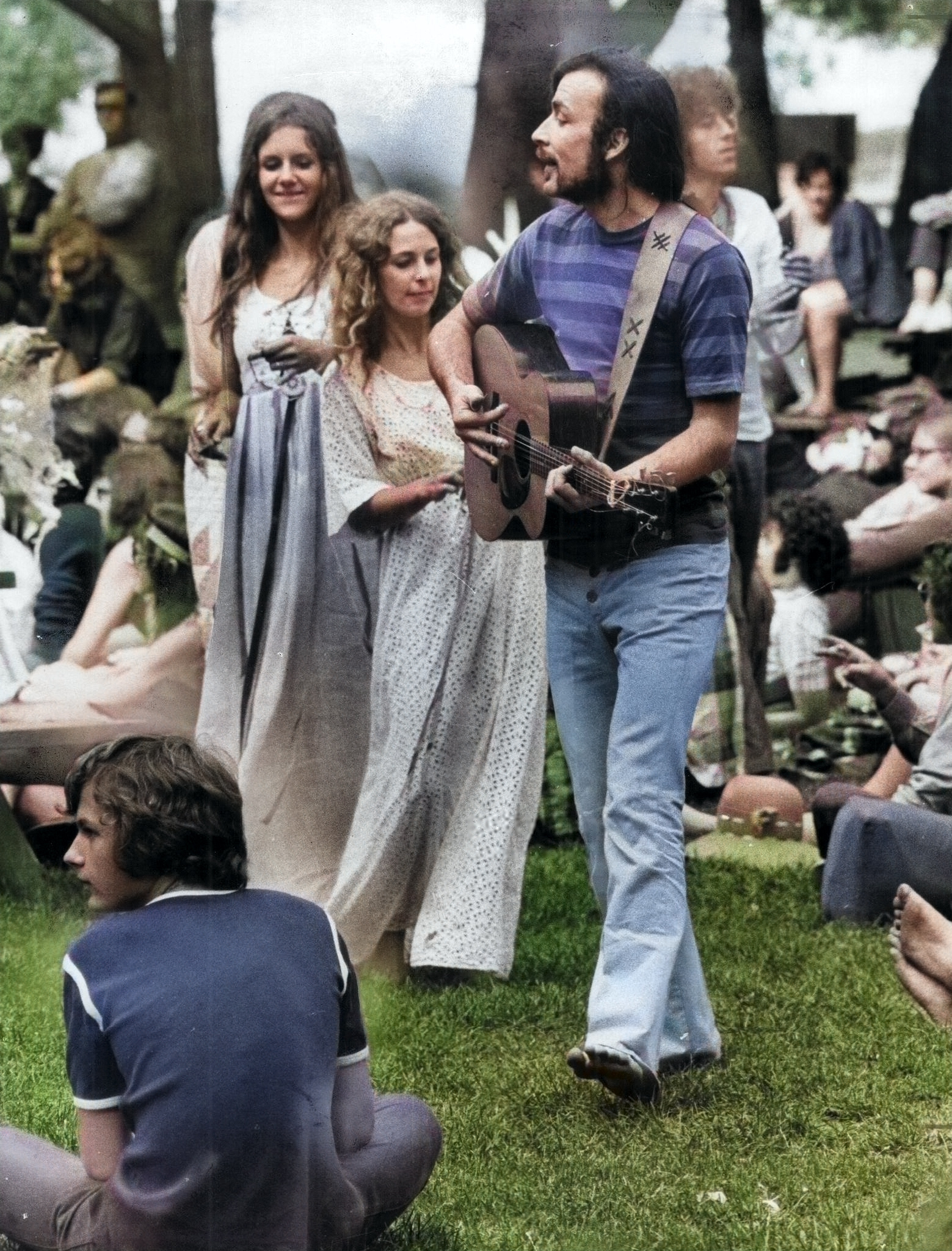
Cedric Smith, his wife Joan, and Dorit Cheyne at the Mariposa Festival (photo by Graham Bezant / colorized)

So, having never been reissued, or even bootlegged, it's easy to understand why a vinyl transfer of Does Not Exist is necessary for proper listening. I have heard two different dubs of this album which have circulated over the years, both predictably noisy and doused with bad noise reduction. This one comfortably tramples both. I've had two clean copies of this LP, neither suitable for clean-up, but I truly lucked out by finding a superior one (still in the shrink!) from the collection of an old Acid Archives contributor, which truly plays its grade. This is one of the early '70s repressings (probably pressed circa 1971-72), which according to the research of C.F. utilizes new stampers with improved fidelity over the "two-eye" originals. This is easy to believe, as it tends to be the case with most LPs released on Columbia -- contrary to the usual collector strategy of finding the earliest first pressings.


Mastering note: as usual, I have tried to create this digital master with as much faithfulness to the original master recording (and to the original artistic intention) as possible. There are some tape dropouts at the end of side 1 which have been left intact to reflect the original recording.

The Perth County Conspiracy:
Cedric Smith: guitar, vocals, readings, maracas, tangents
Richard Keelan: guitar, vocals, timpani, keyboards, fire, dulcimer, penny whistle

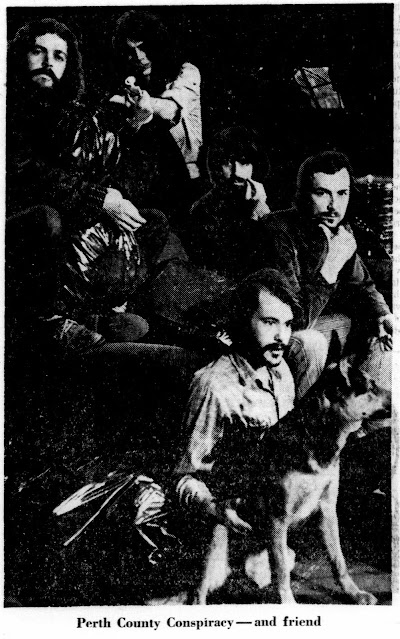
Photo from The Hudson Star, 12 February 1970
Michael Butler: electric bass
Fred W. Baue: ukelin on tr. 13
the rotten goodwood barnwood band and chorale
"... and a cast of thousands ..."

Track listing:
1) "Midnight Hour" — 6:46
  • (i) "You've Got To Know"
  • (ii) "Love To Make"
  • (iii) "You've Got To Know (Reprise)"
2) "Epistle To A Borderliner" — 2:02
3) "Easy Rider" — 4:45
  • (i) "Easy Rider"
  • (ii) "Americanadian Way"
4) "Truth And Fantasy" — 5:51
  • (i) "Truth And Fantasy"
  • (ii) "Come To The Edge"
  • (iii) "Fantasia"
  • (iv) "Truth And Fantasy (Reprise)"
5) "Don't You Feel Fine" — 2:46
6) "You Have The Power"
— 4:52
7) "Keeper Of The Key"
— 3:23
8) "Lady Of The County"
— 3:32
9) "Listen To The Kids"
— 3:00
10) "Trouble On The Farm"
— 2:19
11) "Excerpt From 'As You Like It'"
— 1:25
12) "The Dancer"
— 5:44
13) "Crucifixation Cartoon"
— 6:27

Equipment Lineage:
– Audio-Technica VMN40ML stylus on AT150MLx dual moving-magnet cartridge
– Audio-Technica AT-LP1240-USB direct drive professional turntable (internal stock preamp/ADC removed)
– Pro-Ject Phono Box S2 Ultra preamp with dedicated Zero Zone linear power supply
– Focusrite Scarlett 6i6 MkII (96 kHz / 24 bit)
– Adobe Audition CC 2020 (recording)
– iZotope RX 8 audio editor (manual declicking, EQ subtraction, additional adjustments)
– Audacity 2.3.3 (fades between tracks, split tracks)
– Foobar2000 v1.6.6 (tagging, dynamic range analysis)
 
Full album available for listening on YouTube here: https://youtu.be/sRtGCvOM3Zo
 
Thanks for taking the time to read my posts and check out my blog. I'd greatly appreciate it if you leave a small comment below. Notes from my readers are what inspire me to keep going. Thanks!
MEGA: https://mega.nz/folder/Y1x0CS4B#5IOQoXInGuwrLOEYUw2mPQ

Enjoy!  :)

"Perth County's happy hippie Conspiracy" -- full-page feature in the Toronto Daily Star, 15 August 1970

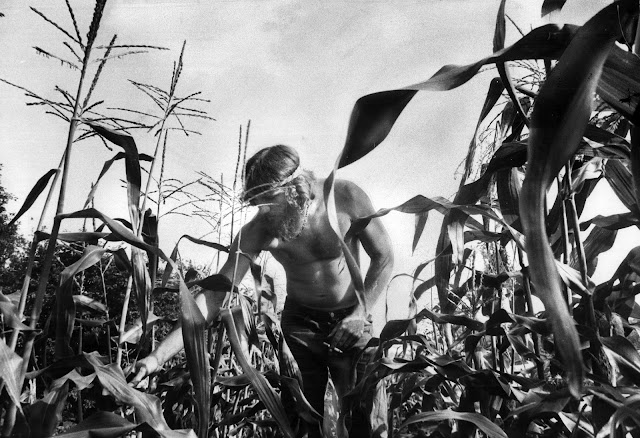
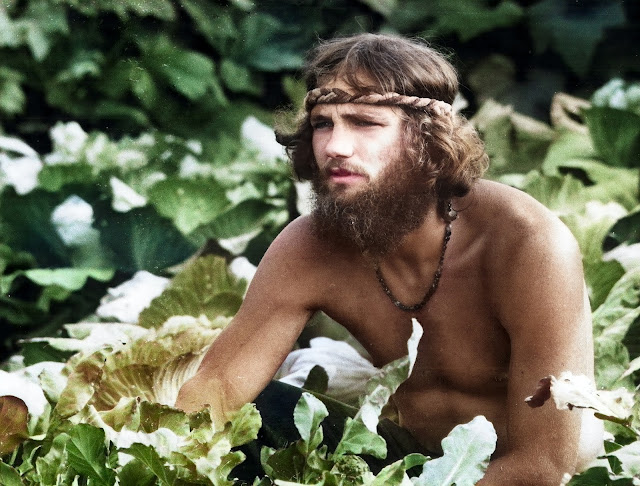
Jim Cairns tending the Conspiracy garden (photos by Graham Bezant // bottom colorized)


Further reading:
- A wonderful blog post & interview of Richard Keelan by Brent Marley (Psych Trail Mix)
- also a nice review by Patrick Lundborg
- the liner notes in the Flashback reissue of the CBC Radio album (available here)

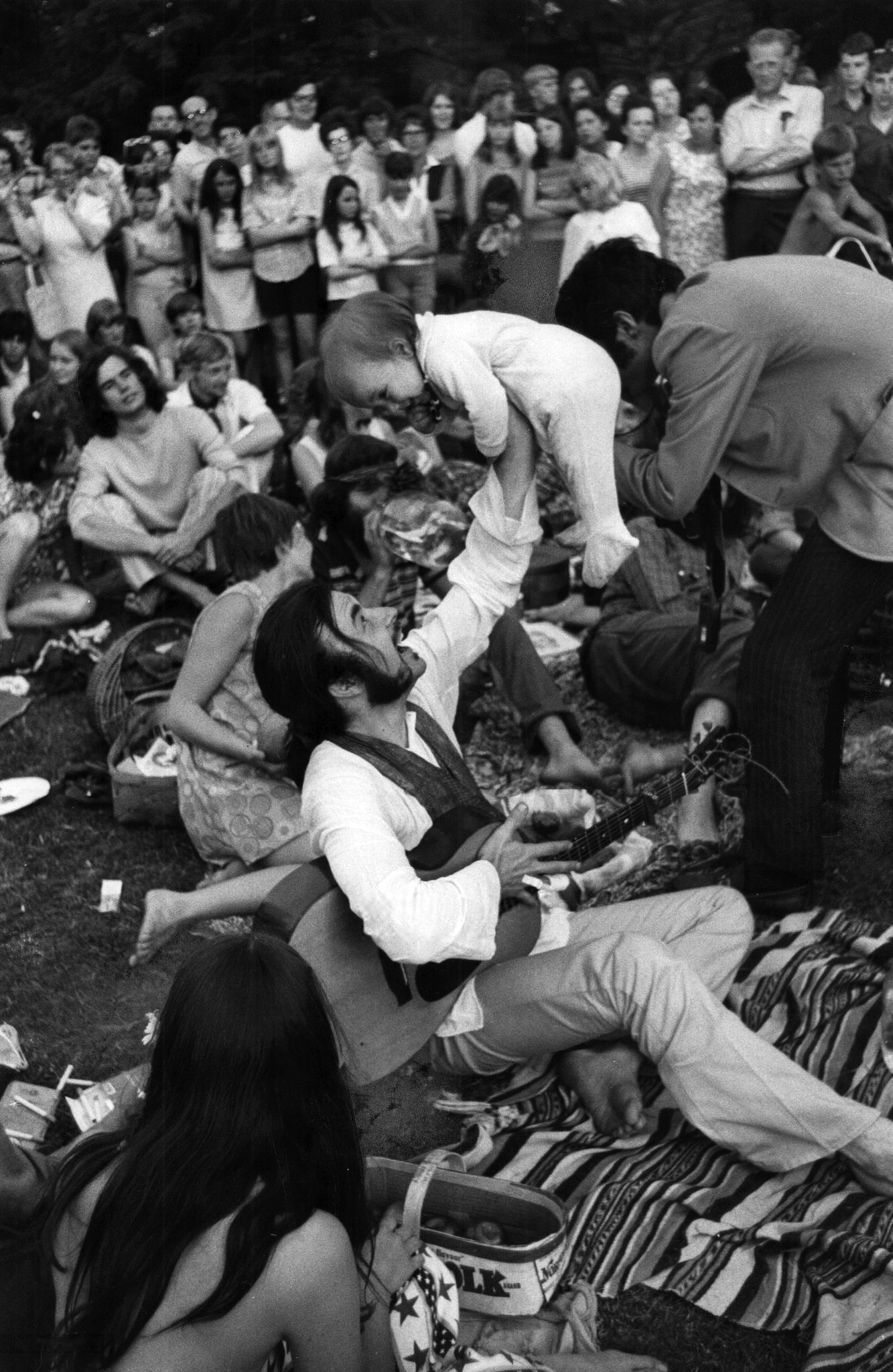
Cedric Smith holds Richard Keelan's 1-year-old daughter Caitlin at Stratford Memorial, 8 June 1970 (photo by Harold Barkeley)